A low bass figure keeps returning. Around it, a tambura sustains its fine, buzzing resonance; harp and soprano saxophone have room to move. That relationship gives Journey in Satchidananda its extraordinary poise. Released by Impulse! in 1971, Alice Coltrane’s five-track album brings her piano and harp into an ensemble shaped by jazz improvisation and her growing involvement with Indian spiritual practice. It is an inviting place to meet a composer whose idea of intensity could accommodate both a firm foundation and considerable freedom.
The familiar description “spiritual jazz” identifies something important here, but it can leave the people out. The record grew from working friendships, a new teacher and decisions about how instruments should coexist. Coltrane’s official discography credits her as composer and co-producer, alongside producer Ed Michel. This was music she actively organized, from its personnel to the space between its sounds.

An old friendship, a new direction
One revealing presence is Vishnu Wood, the oud player on the closing “Isis and Osiris.” A bassist also known to Coltrane as Bill, Wood had worked with her in vibraphonist Terry Gibbs’s band. In a 1987 radio interview with Dolores Brandon, he remembered their habit of trying different harmonies after Gibbs finished soloing. By Wood’s account, the bandleader was unsettled by these experiments. Alice was already developing ideas beyond the group’s customary swing vocabulary. The recollection restores a useful sense of chronology: the young pianist was an inquisitive colleague with an evolving musical language before she became John Coltrane’s wife.
Wood also helped connect her musical and religious lives. Alice later recalled to The Wire running into this old Detroit friend in New York and asking what he was studying. He told her about his guru, Swami Satchidananda, and invited her to hear him speak. She remembered a gathering in which young people felt welcomed into a family. The dedication on Journey thus has a human route behind it: an existing friendship opened onto a new community.
By then, John had died in 1967, and Alice was raising four children while developing her own records and handling his recorded legacy. The work involved practical skills as well as musical ones. In contemporary remarks reproduced by historian Lauren Du Graf, she described learning to edit tape and operate the control board by watching engineers. The basement studio in the family’s Dix Hills home became an important workplace. The first four tracks of Journey were recorded there on November 8, 1970, according to the album’s session credits.


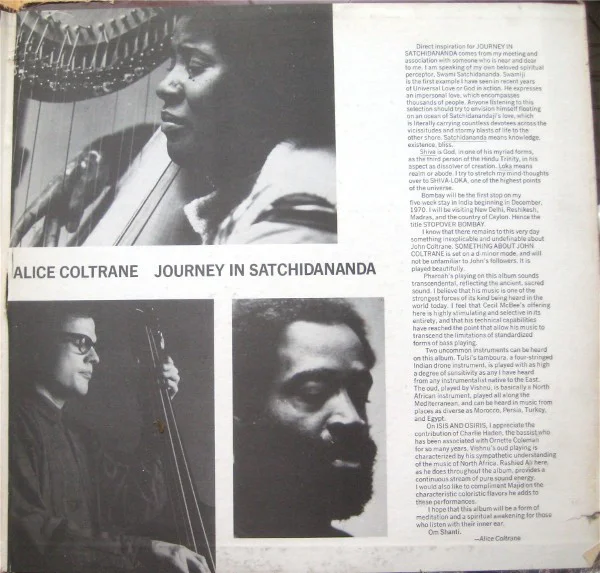
There is a small but telling future tense in her original liner notes. Explaining “Stopover Bombay,” Alice writes of an upcoming five-week visit to India beginning in December 1970. The album was taking shape before that journey. Its titles register anticipation and study as well as dedication; they need not be read as musical postcards from places she had just visited. A direction in her life was already becoming an approach to composition.
Giving each sound room
The liner notes also reveal how closely she attended to the balance of the ensemble. Alice explains that Tulsi’s tambura, a four-string drone instrument, would be difficult to hear inside heavier instrumentation. That observation makes the record’s spaciousness tangible. A drone sustains a tonal reference rather than leading a tune through a sequence of chord changes. Allowing it to remain audible changes what the other musicians can do: motion becomes especially vivid against something that stays.
On the title piece, Cecil McBee’s repeating bass figure gives that stillness a pulse. Pharoah Sanders, the soprano saxophonist who had also played alongside Alice in John’s late band, can stretch a phrase without making the music lose its center. Rashied Ali’s drums and Majid Shabazz’s bells and tambourine provide different kinds of movement. The arrangement invites attention at several scales: the bass pattern, the sustained resonance, a saxophone phrase, the attack and decay of a plucked string. Its apparent ease depends on these parts remaining distinct.
The harp makes this especially clear. A sweep across its strings can occupy a large register without filling every instant with a new chord. Individual notes leave traces as the next ones arrive. For a newcomer, following those decays is as useful as following a solo. On “Shiva-Loka,” consider how the harp’s flights interact with percussion rather than hearing the instrument only as a sign of serenity. The music can gather energy while retaining its openness.
Alice’s piano on “Stopover Bombay” and “Something About John Coltrane” changes the weight of the record. The compact former piece interrupts the longer spans around it; the latter gives her keyboard language much more room. Andrew Katzenstein’s account in The New York Review of Books usefully places this period alongside her Detroit bebop and church background. Those histories help explain why Indian instruments and devotional titles are only part of the picture. Her established musical experience remains active within the new setting.


“Isis and Osiris” changes the ensemble itself. Recorded live at New York’s Village Gate on July 4, 1970, it features Charlie Haden on bass and Wood on oud, a plucked, short-necked lute. The session record separates this group from the studio band: Wood is not playing throughout the album. His presence at the close brings that earlier friendship into the foreground. The longer performance also gives the album another perspective on its central concern, how a group can move freely while preserving a shared character.
Later listeners have found different ways into that space. In her 2019 Pitchfork review, Josephine Livingstone emphasizes the emotional movement within the arrangements. Moon Duo musician Sanae Yamada, speaking to The Irish Times, singles out its use of unfilled space and its lasting effect on her desire to make music. Both responses point toward an album that keeps inviting participation rather than prescribing a single mood.
Alice herself resisted an overly settled account of her sound. When interviewer Stuart Nicholson characterized her music as calmer than John’s in 2004, she explained that expression responded to the circumstances of life. That is a rewarding way to approach Journey in Satchidananda: attend to how its steadiness accommodates changing pressure, movement and feeling. A secure center gives the players somewhere to begin, and somewhere to return.
Listen: Alice Coltrane featuring Pharoah Sanders, “Journey in Satchidananda”, supplied by Universal Music Group to Alice Coltrane’s official YouTube artist channel. Follow the relationship between McBee’s bass pattern and the tambura as the harp and saxophone enter.
Sources and further reading
- Alice Coltrane’s official archive: album credits and original sleeve scans
- Dolores Brandon’s interview with Vishnu Wood, recorded at WBAI, October 1987
- Alice Coltrane’s Wire interview, reproduced by Detroit Artists Workshop
- Lauren Du Graf, “Alice Coltrane: The Artist in Ascension,” Everything Jazz, 2024
- New York Public Library: personnel and recording-session catalogue
- Andrew Katzenstein, “Alice Coltrane’s Songs of Bliss,” The New York Review of Books, 2017
- Josephine Livingstone, Journey in Satchidananda, Pitchfork, 2019
- Sanae Yamada in conversation with Niall Byrne, The Irish Times, 2018
- Stuart Nicholson’s interview with Alice Coltrane, November 3, 2004